
Venison Tartare
Venison tartare is polarizing. Some think eating it is a death sentence. Others treat it like any other dish.
I'm not a health expert, but in over 10 years of eating venison tartare, I've never had an issue.
Let's look at the science.
The Two Main Threats: Bacteria and Parasites
Bacteria is the easier concern to address. Wild game doesn't have the antibiotics farmed meat does, but proper handling solves most problems:
- Field dress as fast as possible
- Butcher in a chill room, or as quickly as you can if that's not an option
- Freeze at -4°F for at least 2 weeks
- Defrost in the fridge
- Trim off the outer layer (sear if preferred)
- Consume immediately
This covers bacteria and a good portion of parasite risk. But recently, someone on Reddit suggested you'd get trichinosis from raw venison.
Here's the reality:
- In the United States (2008–2012): The CDC recorded 84 total cases of trichinosis. Of those, 45 were linked to non-pork products. Only 2 cases (roughly 4%) were attributed to deer meat.
- Case Context: Many "deer-linked" cases are suspected to result from cross-contamination when deer meat is processed using the same equipment as infected wild boar or bear, without proper cleaning.
- Biological Rarity: Deer are herbivores. Trichinella is typically transmitted when an animal consumes infected raw flesh. Since deer don't naturally eat meat, they rarely host the parasite.
While it's not impossible to get trichinosis from deer, it's the next thing to impossible if you handle the meat correctly.
The people pushing fear on forums are often the same ones leaving a deer hanging in a 60°F shed for hours before butchering, or dropping it off at a processor to be ground with who-knows-what.
We're not those people. We're food enthusiasts, wild food enthusiasts at that. We hunt our own meat, butcher our own meat, and cook our own meat.
Proper Handling: What "Fast" Actually Means
When I say "field dress as fast as possible," I mean within 30 minutes of the kill, especially in warm weather.
The moment that animal goes down, the clock starts.
Bacteria multiply rapidly above 40°F, and the longer the gut cavity stays intact, the higher the risk of contamination spreading to the meat.
If you can't butcher in a chill room (ideally below 40°F), work fast and keep the meat cold.
Use bags of ice in the body cavity if you're transporting it.
Once you're ready to break it down, work clean: separate knives for different cuts, sanitized surfaces, and no cross-contamination from non-meat sources.
When I say "trim the outer layer," I mean removing the entire surface that's been exposed to air, hair, or handling, usually about 1/8 to 1/4 inch.
This isn't optional. Even with perfect field dressing, the surface is where bacteria live.
If you're extra cautious, sear the outside on high heat for 30 seconds per side, then trim that seared layer off before dicing. You're left with completely untouched, clean meat.
This is the difference between someone who processes their own game and someone who drops it off at a processor where it's ground with 10 other deer. We control every step.
Venison Butchering Diagram
Download my complete venison cut diagram showing every primal cut and the best cooking methods for each—from tenderloin steaks to ground shoulder.
About Tartare
While there's some debate about its origin, tartare is widely recognized as a French classic.
I was first introduced to it in culinary school, along with many other "exotic" dishes.
Since then, I've tried it in restaurants around the world, and I can honestly say nothing comes close to venison tartare.
Why Venison Works Better Than Beef
I've made beef tartare hundreds of times. It's good. But venison tartare is on a different level, and here's why:
Beef tenderloin has marbling, intramuscular fat that gives it richness. That fat coats your palate and can dull the subtle flavors in the meat.
Venison tenderloin has almost no fat. What you're tasting is pure muscle, and that muscle is incredibly buttery in texture without being greasy.
The flavor is clean, slightly sweet, with a mineral quality that beef doesn't have. It's delicate but not bland.
Wild venison also benefits from the animal's diet.
Deer that feed on acorns, wild grasses, and browse have a complexity to their flavor that grain-fed beef simply can't match.
There's a nuttiness to it that plays perfectly with the walnuts and capers in this recipe.
And here's the critical part: only use tenderloin.
The backstrap is close, but it's firmer and doesn't have the same melt-in-your-mouth texture.
Shoulder, shank, neck? Forget it.
Those cuts are full of connective tissue and need low, slow cooking.
Tenderloin is the only cut where the muscle fibers are tender enough to eat raw without chewing through rubber.
If you've never had venison tartare and you're comparing it to beef in your head, stop. This isn't a substitute. It's its own thing, and it's better.
Making This Dish
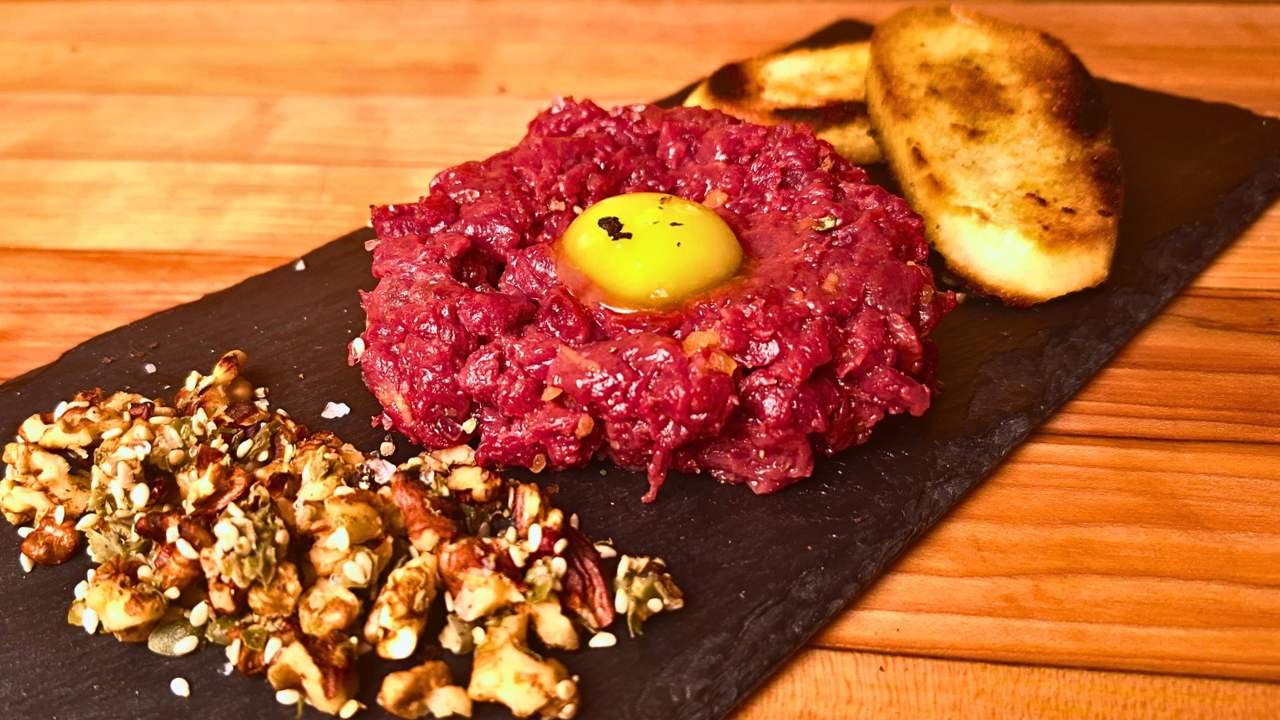
Making tartare couldn't be simpler. The longest process is the sides. For this recipe, I chose a nut rubble with capers to accentuate the nutty flavor of the venison.
The macerated shallots add sharpness to cut through the richness, and the black garlic-Dijon brings a creamy, umami depth.
The flavor is already there. You don't need to do much to build or create it. Your main focus should be on food hygiene.
Nail that, and everything else falls into place.
Venison Tartare
Ingredients
- The Silk (The Binder)
- The Protein & Aromatics
- The Black Gold (The Swipe)
- The Forest Rubble (The Side)
- The Finish
Instructions
- The Infusion & Emulsion (The "Silk"): Brown the 3 tbsp butter in a small pan until it smells like hazelnuts. Add crushed juniper and sherry. It will sizzle; let it cook out for 20 seconds. Strain into a bowl. Chill in the fridge until it reaches a "pomade" (soft paste) consistency. Whisk in 1 quail egg yolk until it's a thick, golden lacquer. Set aside.
- The Acid Prep: Soak the minced shallots in the ACV for 10 minutes. Drain thoroughly in a fine-mesh sieve. Press out the extra liquid so they don't make the plate soggy.
- The Rubble: Dry-toast the 6 whole walnuts and sesame seeds until fragrant. Rub the warm walnuts in a towel to remove skins, then crush them into "pebbles and dust." Mix the crushed nuts, sesame, drained shallots, capers, and parsley in a small bowl.
- The Black Gold: Mash the black garlic cloves and Dijon together. Use a drop of ACV or water to make it a smooth, spreadable paste.
- The Meat: Hand-dice the 9.5 oz venison into 3mm cubes while it's ice-cold. In a chilled bowl, toss the meat with lemon zest and black pepper. Fold in the Juniper-Butter Silk until the meat is glistening.
- The Bread: Pan-fry the baguette slices in butter until golden-brown and crisp.
- Final Assembly: The Swipe: Use a spoon to "swoosh" the Black Garlic-Dijon paste onto the plate. The Meat: Ring-mold the venison in the center. Make two small divots on top. The Crown: Drop the remaining 2 quail yolks into the divots. Season them with Maldon salt. The Garnish: Pile the Forest Rubble neatly next to the meat. Serve: Arrange the hot bread and eat immediately.